
Attendance
Why attendance matters
Why is coming to school every day important?
Children who attend school regularly:
✅ Make better academic progress
✅ Feel more confident in their learning
✅ Build stronger friendships
✅ Develop resilience and independence
✅ Feel more connected to their school community
Missing school doesn't just mean missing lessons. Children can miss important discussions, practical activities, group work, sporting opportunities and special experiences that cannot easily be caught up at home.
Every day counts.
When should I keep my child off school?
Should I send my child to school?
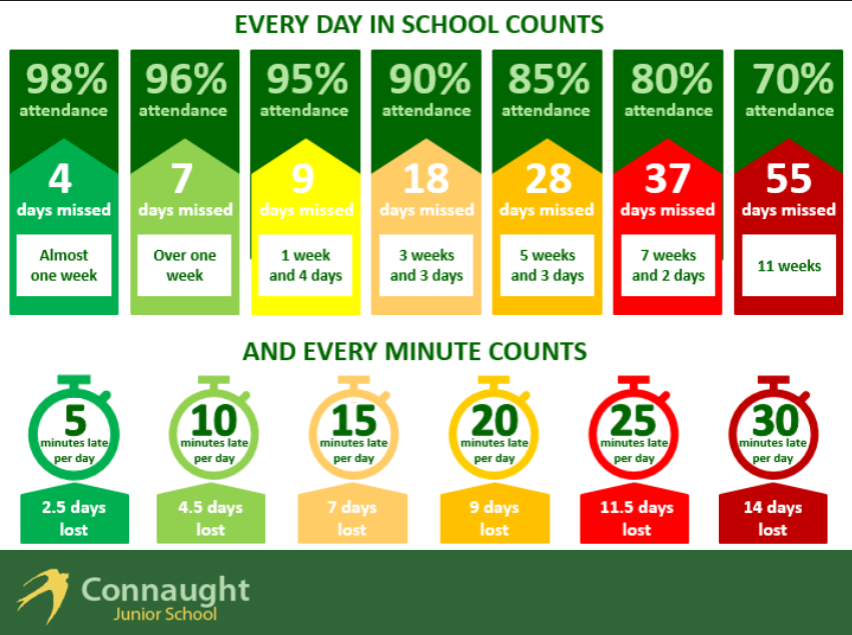
Many minor illnesses can be managed while attending school.
Children can usually attend if they have:
- A mild cold
- A cough
- A runny nose
- Mild sore throat
- Minor headache
Children should normally stay at home if they:
- Have a high temperature
- Are vomiting
- Have diarrhoea
- Have a contagious illness requiring keeping away from others
If you are unsure, please contact the school office for advice.
Useful NHS Links:
Need some support?
If you have any questions about attendance or need help, please contact the school for support.
We are here to help.
Alternatively, you can scroll down to the Attendance Hub section of our website where there are lots of useful links, hint and tips, as well details of the support on offer.
Medical Appointments
Appointments During School Time
Where possible, please arrange:
- Dentist appointments
- Optician appointments
- Routine medical appointments
outside of the school day.
We understand this is not always possible and appreciate your support in helping children maximise their learning time.
At Connaught we have six extra days holiday each school year. Please ensure you maximise the use of this holiday time to arrange routine appointments.
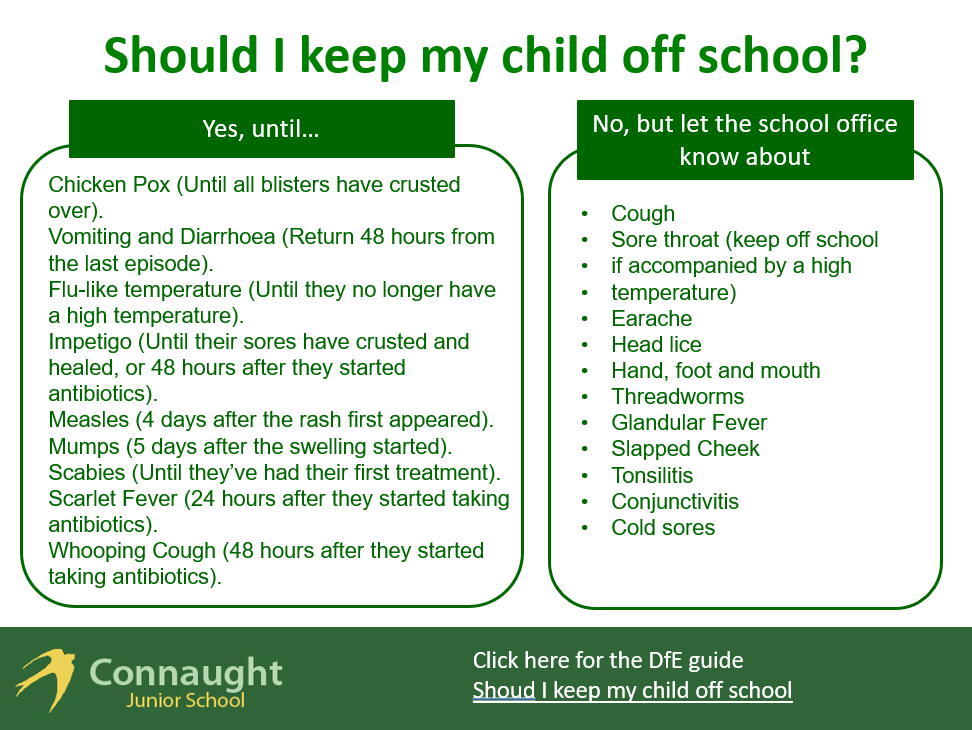
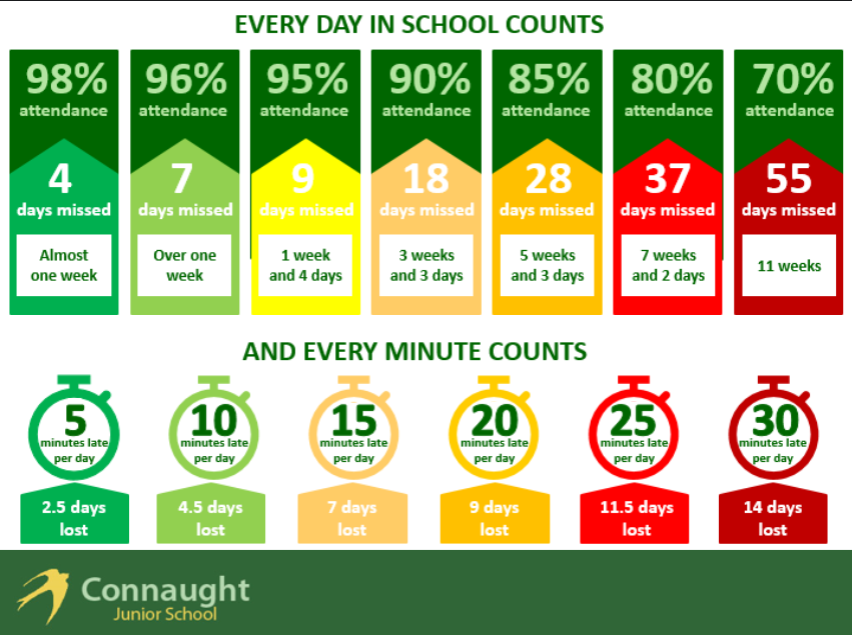
What do attendance percentages mean?
Our school attendance target is 96%. Last year our whole school attendance figure was 95.3%.
We find it helpful to look at attendance as days of learning lost and not just percentages.
Did you know?
✅ 95% attendance still means missing around 10 school days each year.
✅ 90% attendance means almost four weeks of learning missed.
✅ 90% attendance is classed as persistent absence by the DfE.
✅ 50% attendance is classed as severe absence by the DfE.
✅ Children with better attendance are significantly more likely to achieve expected standards at KS2 and strong GCSE grades later on.
Attendance Matters Every Day
At Connaught Junior School, we know that every day in school counts. National research from the Department for Education shows a clear link between attendance and achievement.
Children with higher attendance in Year 6 are more likely to achieve the expected standard in Reading, Writing and Maths, and pupils with strong attendance habits are significantly more likely to achieve strong GCSE results later in their education. Missing school means missing vital learning, classroom discussions, friendships and opportunities to build confidence.
Just 90% attendance means missing nearly four weeks of school across the year and is officially classed by the DfE as persistent absence.
By working together to achieve excellent attendance, we can give every child the very best chance of success now and in the future.

Attendance Myth Busters
Regular attendance gives children the very best chance to learn, build friendships, develop confidence and enjoy all that school has to offer. Here are some common myths about attendance and the facts behind them.
Myth 1: "One day off here and there doesn't really matter."
✅ Fact: Every school day counts.
Missing just one day every two weeks adds up to around 19 days missed in a school year. That's almost four weeks of learning, friendships and school experiences.
Every day in school gives children the best chance to learn, make progress and feel connected to their friends and teachers.
Myth 2: "My child is keeping up with their work, so attendance isn't important."
✅ Fact: School is about much more than academic work.
Children develop confidence, friendships, teamwork, communication skills and resilience through being in school every day.
These experiences cannot be fully replaced with work completed at home.
Myth 3: "A few minutes late won't make much difference."
✅ Fact: Lateness adds up quickly.
Arriving late can mean missing important instructions, morning routines and opportunities to settle into learning.
Children who arrive on time are more likely to start the day feeling confident, calm and ready to learn.
Myth 4: "It's only primary school. Attendance matters more when they're older."
✅ Fact: Good attendance habits start early.
The routines children develop in primary school often continue into secondary school and beyond.
Excellent attendance helps children build positive habits that support lifelong success.
Myth 5: "Taking a holiday in term time is cheaper, so it's worth it."
✅ Fact: Learning continues every day.
Even a short holiday can mean children miss key lessons, class discussions, practical activities and opportunities to build on previous learning.
It can be difficult for children to catch up when they return.
At Connaught we have 6 extra holiday days a year. This means that families can take advantage of cheaper holiday prices compared to other families at different schools.
Myth 6: "If my child is worried or anxious, staying at home is best."
✅ Fact: We want to help.
Sometimes children feel worried about friendships, learning or other situations.
While occasional rest may be needed, regular absence can make worries harder to overcome. It is also important that we teach all our children to be resilient in the face of challenges. Challenges are part of life. Overcoming worries together can be a way to build this resilience.
Please talk to us early so we can work together to provide support.
Myth 7: "My child doesn't want to come to school today."
✅ Fact: Most children have days when they don't feel like coming to school.
Just like adults sometimes don't feel like going to work, children can have off days too.
A positive morning routine and regular attendance often help children settle quickly once they arrive.
Look for support in our Attendance Hub for how to structure a positive and calm morning routine.
Myth 8: "Missing a Friday or Monday occasionally isn't a problem."
✅ Fact: Every lesson builds on previous learning.
Missing the start or end of the week can mean children miss important teaching, introductions to new topics or opportunities to review and consolidate learning.
Myth 9: "If my child has a minor cough or cold, they must stay at home."
✅ Fact: Children can often attend school with minor illnesses.
Most coughs, sniffles and mild colds do not prevent children from learning.
If you are unsure whether your child should attend, please contact the school office or refer to NHS guidance. Here is the link to the NHS advice on when to keep your child off school: Should I keep my child off school?
Myth 10: "Attendance only matters if it falls below 90%."
✅ Fact: Every percentage point matters.
Even attendance that looks quite high can quickly add up to significant amounts of lost learning, friendship time and important school experiences.
Celebrating Attendance
We Celebrate Attendance
We recognise the effort that families make to ensure children attend school regularly. We know it is not always easy.
Throughout the year we celebrate:
- Improved attendance
- Excellent attendance
- Punctuality
- Class attendance achievements
Our focus is always on encouraging positive habits and supporting children to be in school every day that they can be. We want all our children to be noticed, valued and recognised.
Miss McGann shares weekly attendance for each year group in a Monday assembly, as well as class attendance. The two best performing classes get to keep Attendance Toffee in their classrooms for the week.
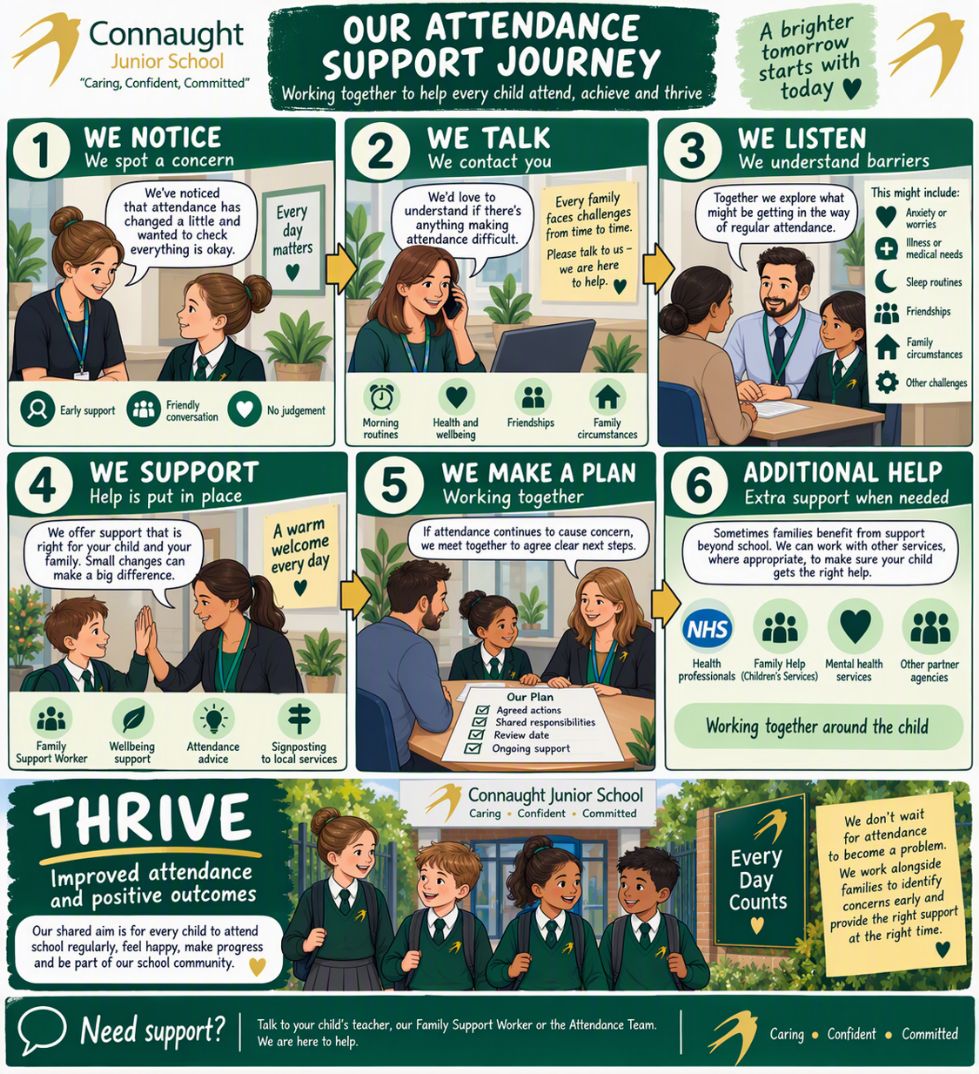
Our Attendance Support Journey
Our Attendance Support Journey
At Connaught Junior School, we know that there can be many reasons why a child may find it difficult to attend school regularly.
Our approach is always supportive, collaborative and child-centred. We aim to identify concerns early, understand any barriers and work together with families to help children attend, achieve and thrive.
Please Talk to us Early
The sooner we know about a difficulty, the sooner we can help.
Whether your child is experiencing anxiety, friendship difficulties, health concerns, sleep issues or changes at home, we encourage you to contact us as early as possible.
Many attendance concerns can be resolved quickly when families and school work together.
You do not need to wait until attendance becomes a significant concern before asking for help.
Step 1: We Notice
If attendance begins to decline, or we notice a pattern that causes concern, we will contact you to check how things are going.
This is simply an opportunity to talk and see whether any support may be helpful.
Step 2: We Listen
We want to understand what may be making attendance difficult.
This might include:
- Illness or medical needs
- Anxiety or worries
- Friendship difficulties
- Family circumstances
- Sleep or morning routines
- Other challenges affecting daily attendance
Step 3: We Offer Support
Together we will identify solutions and support that may help.
This could include:
- Regular check-ins
- Support from our Family Support Worker
- Wellbeing support
- School-based adjustments
- Signposting to local services
- Family Help referrals where appropriate
Step 4: We Meet and Plan
If attendance continues to be a concern, we will invite parents and carers to an Attendance Support Meeting.
Together we will:
- Discuss attendance
- Explore barriers
- Agree practical actions
- Set achievable goals
- Arrange a review date
Step 5: Accessing Additional Help
Sometimes families need support from services beyond school.
Where appropriate, we may work alongside:
- Family Help
- Health professionals
- Mental health services
- Other partner agencies
Step 6: Ongoing Review
We continue to review progress and provide support until attendance improves.
Our shared aim is for every child to attend school regularly, feel successful and enjoy being part of the Connaught community.
Connaught Attendance Hub
Welcome to the Connaught Attendance Hub
At Connaught Junior School, we know that every family faces challenges from time to time. In this section of our website, you can find support if you are struggling with attendance.
We want every child to feel happy, safe and successful at school, and we know that attending regularly gives children the very best chance to make friends, enjoy learning and achieve their potential.
If your family is experiencing difficulties that are affecting attendance, please talk to us. We are here to listen, support and work together to find solutions.
Our aim is always to build positive partnerships with families because we know that every day in school matters.
Attendance Support for Families
Need some support?
Many attendance difficulties have understandable causes.
These might include:
- Anxiety or worries
- Friendship difficulties
- Sleep problems
- Medical appointments
- Family circumstances
- Housing issues
- Bereavement
- Separation or family changes
Please contact us as early as possible. Call the school office on tel: 01276 472 489 or
email: school@cjs.tamat.org.uk.
If you have a safeguarding concern, contact us at dsl@cjs.tamat.org.uk
Sometimes a small issue can become a much bigger problem if support is delayed.
Our team is here to help.
Meet Our Family Support Worker
How our Family Support Worker can help
Our Family Support Worker can provide advice and support around:
- Emotional wellbeing
- Behaviour at home
- Parenting support
- Attendance concerns
- Family routines
- Signposting to local services
- Family Help referrals
You are not alone. Many families access support at different points in their child's school journey.
Contact: Nadine Verderame at fsw@tamat.org.uk
Sleep and Morning Routines
Healthy Sleep Tips
A healthy sleep routine can help your child feel happy and healthy, which in turn can make mornings easier before school.
Children aged 7-11 typically need between 9 and 12 hours sleep each night.
Helpful routines include:
✅ Same bedtime each night
✅ Screens switched off at least one hour before bed
✅ School uniform prepared the night before
✅ Reading before sleep
✅ Consistent wake-up times
✅ A calm morning routine
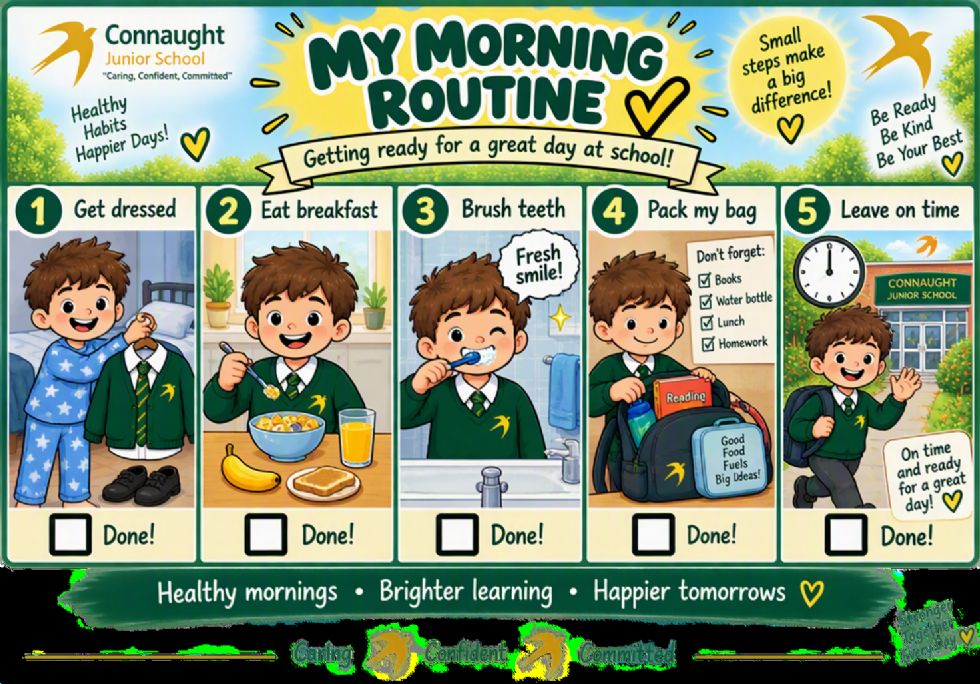
Top Morning Tip
Try using a simple checklist:
- Get dressed
- Eat breakfast
- Brush teeth
- Pack bag
- Leave on time
Children often find visual routines very helpful.
Download our checklists here.
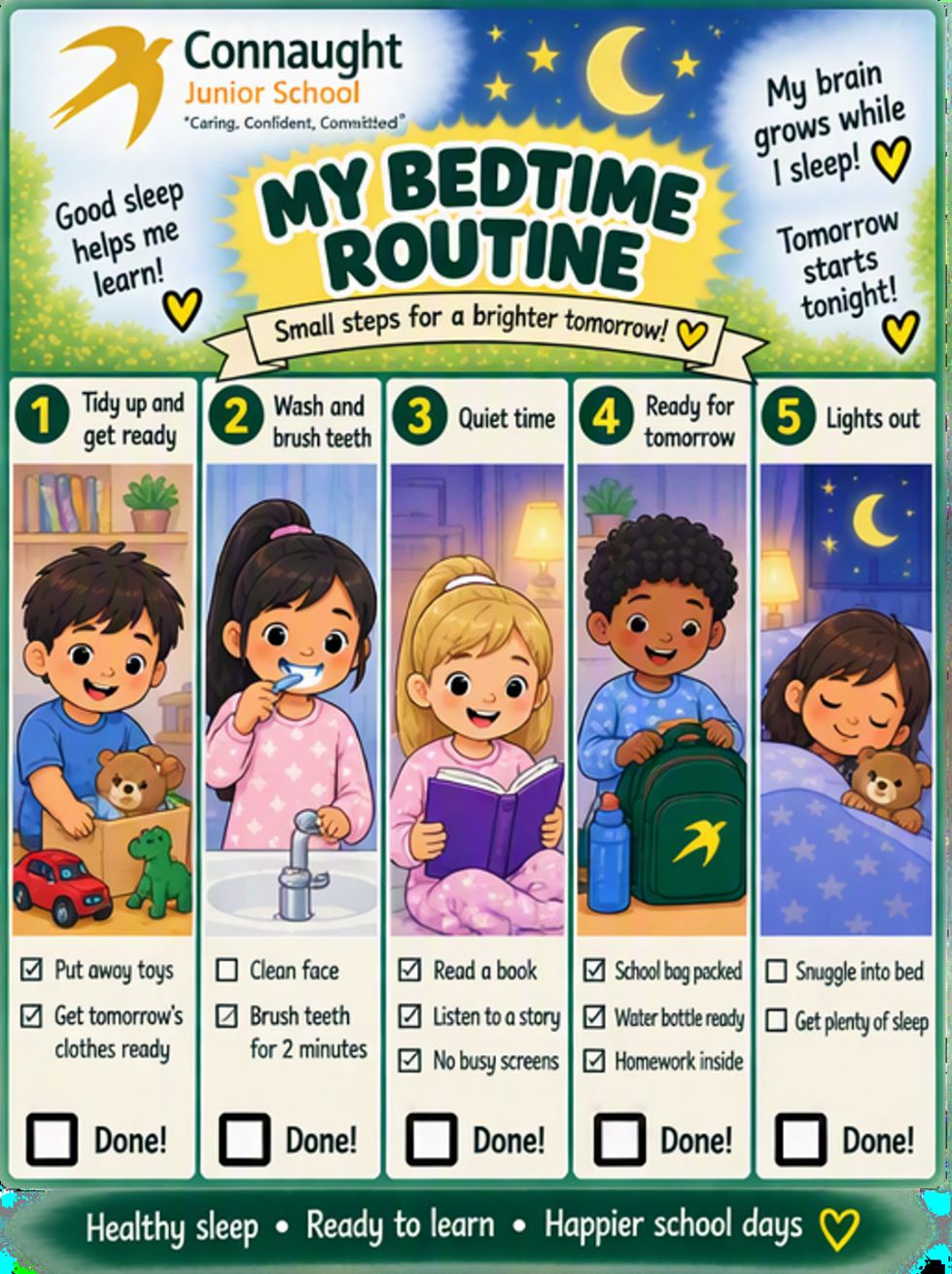
Top Bedtime Tip
- Put screens away
- Brush teeth
- Get tomorrow’s uniform and bag ready
- Read a book
- Get to bed on time – don’t stay up late
- Get a good night’s sleep
Anxiety, Worries and School Avoidance
Helping children feel safe, confident and ready for school
Feeling worried, nervous or anxious is a normal part of growing up. Children may worry about friendships, schoolwork, trying new things, health, family changes or being away from parents. Most worries come and go. However, sometimes anxiety can become overwhelming and begin to affect a child's daily life, including attendance at school. #
The NHS advises that anxiety becomes a concern when it is persistent, getting worse, or preventing a child from enjoying everyday activities.
If your child is worried about school:
Sometimes children can feel anxious about attending school. Children often show anxiety through their behaviour rather than talking about it.
Emotional Signs
- Frequent worries or fears
- Negative thoughts ("Something bad will happen")
- Low confidence
- Irritability or tearfulness
- Becoming upset more easily than usual
Physical Signs
- Tummy aches
- Headaches
- Feeling sick
- Difficulty sleeping
- Nightmares
- Changes in appetite
Behavioural Signs
- Avoiding school
- Not wanting to leave parents
- Avoiding social situations
- Refusing to try new things
- Seeking constant reassurance
These are common signs identified in the NHS children's mental health guidance.
The most helpful approach is usually to seek support early. Please contact your child's class teacher, the Family Support Worker or a member of the leadership team so that we can work together to help your child.
Useful Links
Why School Attendance Matters
When children feel anxious, avoiding the thing they fear can bring short-term relief. However, anxiety often grows stronger when situations are avoided repeatedly.
Mindworks Surrey explains that anxiety can become more intense when we avoid situations that make us anxious. Gradual support and positive experiences help children build confidence over time.
For this reason, maintaining regular school attendance is usually an important part of helping children overcome anxiety.
School provides:
- Routine and predictability
- Friendships and social connections
- Opportunities for success
- Access to trusted adults
- A sense of belonging
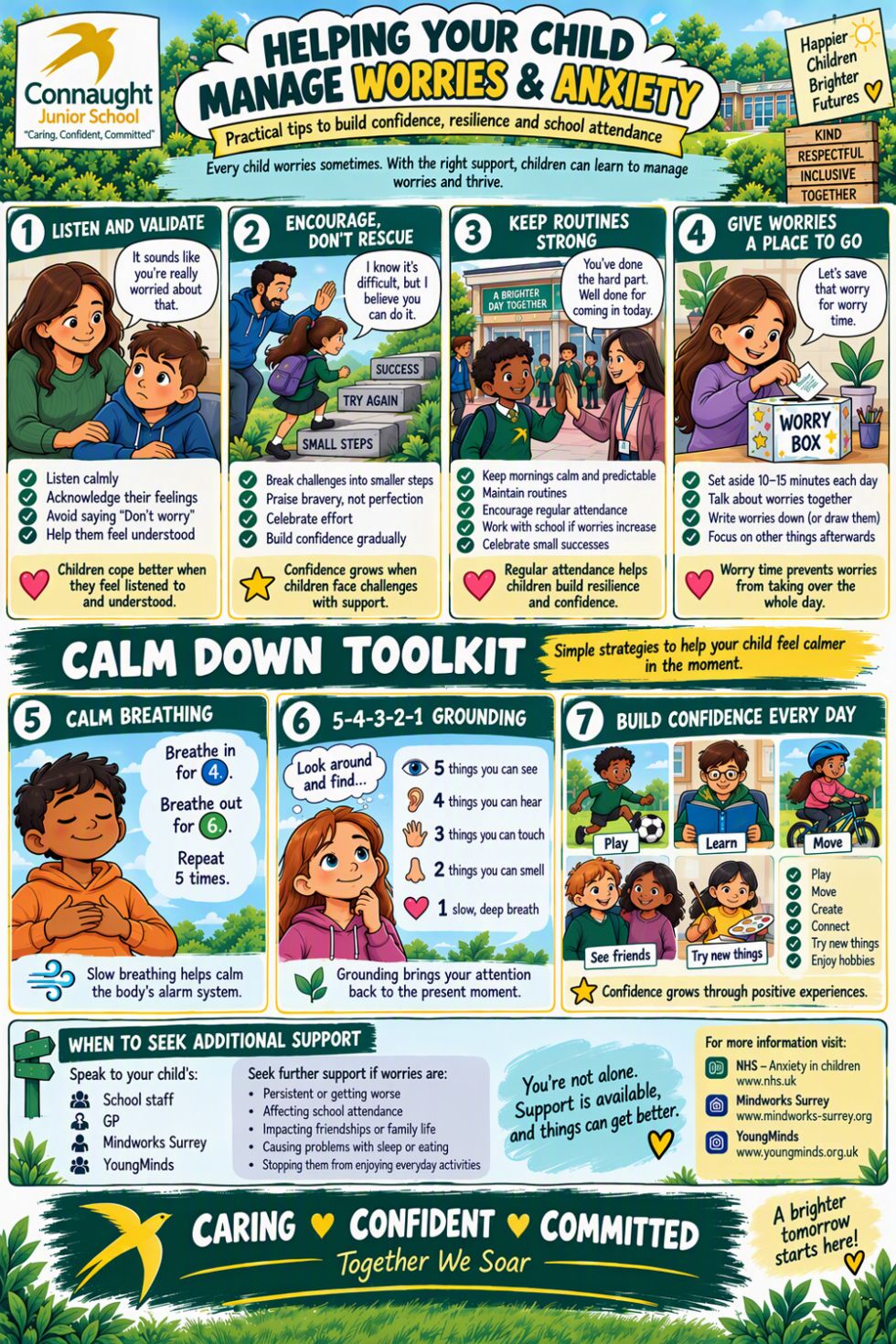
How Parents Can Help
1. Listen and Validate
Try to understand the feeling before solving the problem.
✅ "It sounds like you're really worried about that."
✅ "I can see this feels difficult."
❌ "Don't be silly."
❌ "You've got nothing to worry about."
Acknowledging feelings helps children feel understood and safe.
2. Stay Calm
Children take emotional cues from adults.
If we appear highly anxious ourselves, children may believe there is something genuinely dangerous to worry about.
Try:
- Speaking calmly
- Keeping routines predictable
- Demonstrating healthy coping strategies
3. Encourage, Don't Rescue
It can be tempting to remove every worry for our child.
Instead of:
❌ Letting them avoid the situation completely
Try:
✅ Breaking challenges into smaller steps
✅ Celebrating effort
✅ Praising bravery rather than success
For example:
"I'm proud of you for walking into school even though it felt scary."
4. Keep School Attendance Consistent
Where possible:
- Maintain normal morning routines.
- Avoid extended discussions about whether children should attend.
- Work closely with the school if concerns are affecting attendance.
- Celebrate attendance successes.
Most anxious children benefit from support to remain connected with school rather than prolonged periods away from it.
5. Create "Worry Time"
Some children benefit from setting aside 10 to 15 minutes each day to talk about their worries.
Outside of this time:
"Let's save that worry for worry time."
This helps prevent worries from taking over the whole day.
Simple Anxiety Strategies for Children
Calm Breathing
Encourage your child to:
- Breathe in slowly for 4 seconds
- Breathe out slowly for 6 seconds
Repeat five times.
This helps calm the body's natural "fight, flight or freeze" response
Grounding Exercise: 5-4-3-2-1
Ask your child to notice:
- 5 things they can see
- 4 things they can hear
- 3 things they can touch
- 2 things they can smell
- 1 slow, deep breath
This helps bring attention away from worries and back to the present moment.
Build Confidence Every Day
Encourage:
- Playing outside
- Sports and clubs
- Meeting friends
- Trying something new
- Responsibilities at home
Confidence grows through experience, not by avoiding challenges.
When Should I Seek Additional Help?
Speak to your GP or school if your child's anxiety:
- Persists for several weeks
- Is getting worse
- Causes frequent school absence
- Affects friendships
- Impacts family life
- Prevents them from enjoying activities they previously liked
The NHS recommends seeking professional support when anxiety significantly affects everyday life and self-help strategies are not helping.
Where Can Parents Get Support?
School Support
Your child's school can:
- Listen to concerns
- Create supportive plans
- Help with transitions
- Monitor attendance and wellbeing
- Signpost to additional services
Please speak to your child's class teacher if you have concerns.
NHS
Visit:
NHS Anxiety Disorders in Children
Mindworks Surrey
Mindworks Surrey offers information, self-help resources, advice and mental health support for children, young people and families in Surrey.
Access and Advice Service: Available through the Mindworks Surrey website.
Additional Support
Parent Helpline and online resources for children's mental health.
Advice for families on supporting children's emotional wellbeing.
For urgent advice when you are unsure where to get help.
Emergency Help
If a child is at immediate risk of harm or you are concerned about their safety, call 999 or attend your nearest Accident & Emergency department.
A Final Reassurance
Anxiety is common and highly treatable. With understanding, encouragement, consistent routines and the right support, most children learn effective ways to manage worries and thrive both in school and at home. Working together, families and schools can help children develop the confidence and resilience they need to succeed.
Key Message:
"Be curious about the worry, calm about the feeling, and confident in your child's ability to cope."
Family Help (formerly Early Help)
What is Family Help?
Family Help provides practical support for families experiencing challenges.
Support may include:
- Parenting support
- Emotional wellbeing
- Attendance support
- Financial pressures
- Housing concerns
- Family relationships
- Accessing specialist services
Family Help is voluntary and aims to provide support before difficulties become more serious.
The earlier support is accessed, the more effective it can be.
Please contact our Safeguarding Team at dsl@cjs.tamat.org.uk or our school Family Support Worker if you would like to discuss whether a referral may be helpful. Alternatively, you can contact the School Office who will direct you to someone who can help.
Frequently Asked Questions
My child doesn't want to come to school. What should I do?
Please contact us as soon as possible. We can often help identify the cause and put support in place.
My child is frequently unwell.
Please speak to us. We may be able to support through attendance planning and partnership working with health professionals such as arranging a referral to our school nurse.
We are experiencing difficulties at home.
Please let us know. We may be able to offer support directly or connect you with appropriate services.
Do I need to provide medical evidence?
Sometimes the school may ask for supporting information if absences become frequent or prolonged.
Contact Us
We're Here To Help
If you are concerned about your child's attendance, please contact us as soon as possible.
Together we can identify barriers, find solutions and ensure every child has the best opportunity to thrive at school.
School Office: 01276 472489 or email: school@cjs.tamat.org.uk.
Family Support Worker: fsw@tamat.org.uk